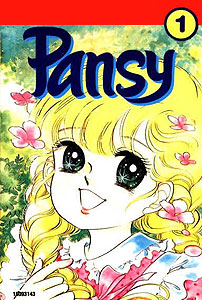
I know it’s been a while, I have been busy (mostly playing Fallout: New Vegas…) but I’m going to try and get back on the wagon again. This time I bring you a title I just finished recently called Pansy by Mariko Okumura. It’s a historical fiction (though starts to drift a little into light fantasy by the end) shoujo title from the late 80s. Pansy is a feral girl, recently found in Africa, living in the wild being raised by chimpanzees. Mark Animal the young man, who found her, takes her back to his European-esque home country of Roland to study her. Pansy meets a slightly older boy than herself named Edo (who in one of the more obvious turns in the story is the prince of the country) who loves her free spirit. Upon hearing the Traumerei played memories of her past start to awaken. Quickly though events start to roll changing Pansy’s life even further. The story of Pansy quickly turns into one of high adventure and political intrigue.
At first it’s just something small as Mark’s fiancĂ© being jealous of Pansy and having a local reporter take photos of the girl acting like a monkey. Soon she is embroiled in the affairs of the royal family as the throne is being usurped by Edo’s jealous cousin Wirald. Something is always happening to Pansy and new people are always coming in and sometimes old characters come back for a surprise. It is what really made this manga really enjoyable though was I never really knew what was going to happen next. So much crazy crap happens, but because Pansy just rolls with it all it just seems to work. She gets lost, becomes a maid, and might be from a noble family. Then when everything looks like it might work out just fine, BAM! everything she has is destroyed. Pansy ends up doing a little bit of everything and ends up in trouble a whole lot but she remains a strong lead through it all.
The writing is kind of odd, while there are story arcs and they have a somewhat normal structure the overall story isn’t so structured and it kind of rambles on into the series next event. Also while most of the story would be considered historical fiction towards the end the story introduces a country where the nobles worship Satan (at this point I gave a hardy WTF?). This apparently grants them some magic powers like staying young and seeing through a crystal ball like a security camera. It’s kind of odd but at that point so many other barmy things had happened I just kind of rolled with it. I also have to note that the scanalations of this series are from different language from the original Japanese. So, it is a translation of a translation and early on it really shows. In the first few chapters the wrong forum of various pronouns are used. Thankfully over the course of the scans the translation gets better.
The art is well done but pretty typical of 80s shoujo so looks a bit dated today. Thankfully, it’s a period piece so it isn’t as dated as some other titles of the time. The art is well drawn and a lot of the formal clothes have very nice details to them. These are drawing you can see that some care went into creating them. I’d also say the screen tone used in this title is very well done, not too much and done with care.
I got to say I enjoyed this title way more than I thought I would. I finished off all eleven volumes in just a couple of days. It was almost like playing Civilization expect instead of one more turn it was one more page just to see what crazy thing would happen next.
Like manga? Like manga so much you read blogs about manga? Then read this blog, because you know...cheese!
Showing posts with label Historical. Show all posts
Friday, March 4, 2011
Sunday, March 14, 2010
Review: A Drifting Life
So this week is a review of the title is A Drifting Life by Yoshihiro Tatsumi. Let me start off by saying, this is a the first title in a while that I enjoyed a whole lot. This manga is an abundance of elements rolled up in one. First and foremost it's a biography of Tatsumi's life, which I feel he really managed to capture different moments in life. I really felt what he was feeling at different points in the story. I felt very drawn into manga, I felt like I could see everything going one before me. An example of this is when he is at Kyoto University to take the entrance exam. He starts to take the exam but the weight of all the numerous things going on in his life at the time drive him to run out in the middle as a whirlwind of emotion overcomes him. I felt almost dizzy during it, I was so drawn into the story. I can't say much about the title as a biography, I really haven't read that many. If they are all this engrossing though, maybe I should read more of them.
Next it is also a view of post war Japan in daily life and pop culture. It really gives a feel for Tastsumi's daily life growing up with his family and going to school. The title as presents the good and the bad of his family in a balanced manner. Sure his Father did some rather idiot things, he isn't painted in a stereotypical bad Father light. (I also learned from this title that during the early post where period Japan used vehicles powered by coal...Sakura Wars makes so much more sense now!) The story also often takes short breaks where Tatsumi will interject with what is going on in pop culture at the time. These make great reference points to the time of the story and to give a general feeling of the world at the time.
On another level it's also a history of not just Gekiga (what Tatsumi is known for) but of manga in general. We see him and his brother doing short four panel strips, admiring early Tezuka, and discussing what manga is. And trust me all of the different people he meets along the way have a different meaning of manga in their hearts. I also got the feeling for just how much western works influenced manga (here's a secret...a whole fucking lot). Tatsumi goes to the movies often and works to incorporate the style of narrative from his favorite films into his work. There is also a great point in the tale where we learn how much on of the first hard boiled novels really influenced Gekiga and manga in general.
The art is a pretty unique style, on one hand it's undeniably manga and Japanese but on the other hand it's not like any art style we see today. It does hearken back to a different time of manga, a time I've only really ever dipped my toes into really. The art is rather expressive and well done and I do think it does a great job of helping immerse one into Tatsumi's world. The problem being is that it doesn't look like today's manga and that will most likely be a turn off for every but the super serious manga fan, or the alternative comics fan.
That being said this is a title that is really worth checking out if you are a anime/manga fan just for the rich history it goes into. With the parts that talked about Osamu Tezuka, really gives life and understanding to the knowledge of just how important he was. That being said this title is really about Gekiga which is another cornerstone that has influenced anime/manga. Without Gekiga perhaps much of the anime/manga anyone who grew up in the 90's loved wouldn't have existed.
A biography is at it's in essence a slice of life story and this was one I felt really engrossed in. It really gave off the feeling something important is happening around these people but even they are a bit oblivious to it. I wanted to meet these people he worked in and live in this world though, there was just some much energy. A sensation that they were on to something. This title is a must of any serious fan of manga, it's also worthing looking at for the personal look of post WWII Japan.
Final Verdict: If history class was this awesome...I would have learned more.
Next it is also a view of post war Japan in daily life and pop culture. It really gives a feel for Tastsumi's daily life growing up with his family and going to school. The title as presents the good and the bad of his family in a balanced manner. Sure his Father did some rather idiot things, he isn't painted in a stereotypical bad Father light. (I also learned from this title that during the early post where period Japan used vehicles powered by coal...Sakura Wars makes so much more sense now!) The story also often takes short breaks where Tatsumi will interject with what is going on in pop culture at the time. These make great reference points to the time of the story and to give a general feeling of the world at the time.
On another level it's also a history of not just Gekiga (what Tatsumi is known for) but of manga in general. We see him and his brother doing short four panel strips, admiring early Tezuka, and discussing what manga is. And trust me all of the different people he meets along the way have a different meaning of manga in their hearts. I also got the feeling for just how much western works influenced manga (here's a secret...a whole fucking lot). Tatsumi goes to the movies often and works to incorporate the style of narrative from his favorite films into his work. There is also a great point in the tale where we learn how much on of the first hard boiled novels really influenced Gekiga and manga in general.
The art is a pretty unique style, on one hand it's undeniably manga and Japanese but on the other hand it's not like any art style we see today. It does hearken back to a different time of manga, a time I've only really ever dipped my toes into really. The art is rather expressive and well done and I do think it does a great job of helping immerse one into Tatsumi's world. The problem being is that it doesn't look like today's manga and that will most likely be a turn off for every but the super serious manga fan, or the alternative comics fan.
That being said this is a title that is really worth checking out if you are a anime/manga fan just for the rich history it goes into. With the parts that talked about Osamu Tezuka, really gives life and understanding to the knowledge of just how important he was. That being said this title is really about Gekiga which is another cornerstone that has influenced anime/manga. Without Gekiga perhaps much of the anime/manga anyone who grew up in the 90's loved wouldn't have existed.
A biography is at it's in essence a slice of life story and this was one I felt really engrossed in. It really gave off the feeling something important is happening around these people but even they are a bit oblivious to it. I wanted to meet these people he worked in and live in this world though, there was just some much energy. A sensation that they were on to something. This title is a must of any serious fan of manga, it's also worthing looking at for the personal look of post WWII Japan.
Final Verdict: If history class was this awesome...I would have learned more.
Labels:
Gekiga,
Historical,
Review,
slice of life,
Yoshihiro Tatsumi
Saturday, February 6, 2010
Scanlation Get: Historie
I'm in the process of moving for a job in another state so a lot of my time is being taken up by that right now. I will still try to update weekly but I think there will only be Scanlation Get! for a few weeks.
This week I am keeping up the theme of “Serious Historical Fiction” with Historie. A title by Hitoshi Iwaaki who is best known for for the sci-fi manga Parasyte. This time we delve even further in the past in to ancient Greece with the life of Eumenes. This is a man who served in many functions in his life including being secretary to a king, a general, and a scholar. Historie is told from the point of view of Eumenes who is a bright and very smart youth (something he puts to good use). He is also friendly and kind, often willing to help those in need. Early in the story his life takes several twists and turns from having a strong and wealthy family, to being a slave, and then meeting Philip II of Macedon which again causes his life to change drastically. We also meet other famous historical characters such as Aristotle and a young Alexander (as in The Great) as Eumenes interacts with them.
A lot of the drama created in the series is based on besting the opponents intelligence. Eumenes often gets out of trouble by being smart and avoiding a fight. Another source of drama is with the many different cultures interacting with each other and how their cultural mores cause conflict with each other. So once again, this series can be kind of dry for those who are not into that type of story, but for those who are it's great. (I find cultural sociology highly entertaining in and of it's self, so I eat this stuff up).
The art in Historie is an interesting topic onto it's self. The characters have decent designs that are functional but nothing that will wow anyone. If you have seen Iwaaki's other work Parasyte the characters look pretty much the same just in period appropriate clothing. What really steps up the art in the series is the amount of detail in it. A lot of manga titles use screen tones which include pre-made backgrounds like generic modern cityscapes. For a titles like Historie, or Cesare they are no pre-made backgrounds all of these have to be drawn in (which I give some serious cred to the mangaka for, because this type of stuff is time consuming). There are many location framing panels or panels with hundreds of soldiers drawn in painstaking detail. Though for Historie this is where things get kind of bizarre. If you are reading it the from the anthology magazine it runs in often a chapters will not be properly inked in. Everything is basically there, it just looks rough. In the collected volumes Iwaaki goes back and finishes all of the art and the difference is huge. The amount of detail in some of the location panels is bewildering. Every little building in a classical city will be drawn in and with some detail. Over all I enjoy the art but it will definitely turn off some. Also it may be worth waiting for the scans of the collected volume to read.
Once again this isn't a title for everyone but for those who like historical or serious stories it is a very good read. Also if you like Iwaaki's other work Parasyte, I highly suggest reading this. Both of very different but both handle a lot of interesting moral themes very well.
This week I am keeping up the theme of “Serious Historical Fiction” with Historie. A title by Hitoshi Iwaaki who is best known for for the sci-fi manga Parasyte. This time we delve even further in the past in to ancient Greece with the life of Eumenes. This is a man who served in many functions in his life including being secretary to a king, a general, and a scholar. Historie is told from the point of view of Eumenes who is a bright and very smart youth (something he puts to good use). He is also friendly and kind, often willing to help those in need. Early in the story his life takes several twists and turns from having a strong and wealthy family, to being a slave, and then meeting Philip II of Macedon which again causes his life to change drastically. We also meet other famous historical characters such as Aristotle and a young Alexander (as in The Great) as Eumenes interacts with them.
A lot of the drama created in the series is based on besting the opponents intelligence. Eumenes often gets out of trouble by being smart and avoiding a fight. Another source of drama is with the many different cultures interacting with each other and how their cultural mores cause conflict with each other. So once again, this series can be kind of dry for those who are not into that type of story, but for those who are it's great. (I find cultural sociology highly entertaining in and of it's self, so I eat this stuff up).
The art in Historie is an interesting topic onto it's self. The characters have decent designs that are functional but nothing that will wow anyone. If you have seen Iwaaki's other work Parasyte the characters look pretty much the same just in period appropriate clothing. What really steps up the art in the series is the amount of detail in it. A lot of manga titles use screen tones which include pre-made backgrounds like generic modern cityscapes. For a titles like Historie, or Cesare they are no pre-made backgrounds all of these have to be drawn in (which I give some serious cred to the mangaka for, because this type of stuff is time consuming). There are many location framing panels or panels with hundreds of soldiers drawn in painstaking detail. Though for Historie this is where things get kind of bizarre. If you are reading it the from the anthology magazine it runs in often a chapters will not be properly inked in. Everything is basically there, it just looks rough. In the collected volumes Iwaaki goes back and finishes all of the art and the difference is huge. The amount of detail in some of the location panels is bewildering. Every little building in a classical city will be drawn in and with some detail. Over all I enjoy the art but it will definitely turn off some. Also it may be worth waiting for the scans of the collected volume to read.
Once again this isn't a title for everyone but for those who like historical or serious stories it is a very good read. Also if you like Iwaaki's other work Parasyte, I highly suggest reading this. Both of very different but both handle a lot of interesting moral themes very well.
Labels:
Historical,
Historie,
Hitoshi Iwaaki,
Scanlation Get,
Seinen
Saturday, January 30, 2010
Scanlation Get: Cesare
The new Scanlation Get! is Cesare, which is a title that aptly calls its self “Serious Historical Fiction”. (This title is serious business!) Mangaka Fuyumi Souryo (Eternal Sabbath) did research with a Dante scholar to bring the life of Cesare Borgia to the manga page.
The story is from the view of the character Angelo da Canossa who has recently arrived at a cloistered school for the children of nobles, or the rich and powerful. Smart, but naive in the world of political intrigue Angelo is left at a disadvantage when the different students associations begin to play for power within the school. Through a series of events Angelo is saved by Cesare. Angelo is immediately captivated by him. Cesare is charismatic, smart, and outwardly kind. Though he lives in a harsh world of hidden darkness where even the smallest slight can cause immense political danger. Cesare has keen political sense he wields with surgical precision in all this darkness. It is through Angelo we learn more about Cesare, allowing us to see both the light and darkness of this character. There is a lot of maneuvering, and manipulation of power with the various associations within the school. This leads to a lot of political intrigue in the title.
The art in this is marvelous, there is a huge attention to detail in every page. The clothing is period appropriate which means lots of ruffles and darting, all of which is drawn in detail. Each association has very distinct clothing also, which is very helpful in a title with a number of characters and sides to take. Cesare features many framing panels, to help define the setting, which are drawn in such detail it is astounding. Every character has a simple but unique face, and the detail in some of the hair is just insane. Over all an outstandingly well drawn title.
Ceasare reminds me a lot of Rose of Versailles (only more male) which had a similar story telling device with Oscar and Marie Antoinette. What makes Rose of Versailles and Cesare interesting was the wheeling and dealings of the nobles at court (or in the case of Cesare the students at the school). I will admit Cesare maybe to dry for a lot of people as most of the “action” is in fact political maneuvering and intrigue which leads to people talking...a lot. The “action” is in the “words” (Shakes fist). Though for anyone that likes “Serious Historical Fiction” I would highly recommend it.
Labels:
Cesare,
Fuyumi Souryo,
Historical,
Scanlation Get,
Seinen
Subscribe to:
Posts (Atom)


